


How does the school system work?
Elementary school
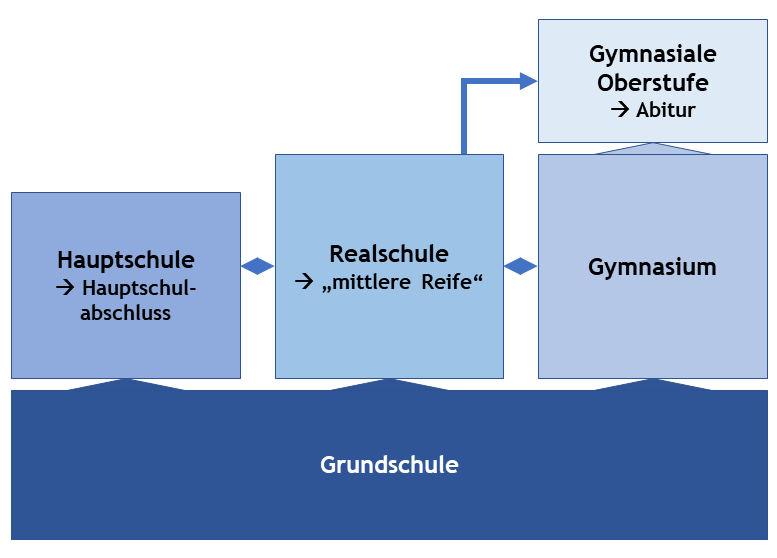
From the age of 6, children in Germany are required to attend school. That is, then they have to attend a public or private school. Only lessons at home are not possible. Primary school usually lasts 4 years, in Berlin and Brandenburg 6 years. The children receive certificates from the beginning, first mostly written assessments, later grades from 1 to 6, with 1 being the best grade.
Secondary education
The Realschule comprises the 5th to 10th grade. Here, too, practical subjects play an important role. Often, however, a second foreign language can also be chosen. At the end of the 10th grade, the Realschule exam is due. After an oral examination and written examinations in German, maths and English, the students acquire the Realschulabschluss, the "mittlere Reife". With a certain grade point average, it is considered a "qualified Realschulabschluss".Various options are now available: vocational training or attendance at a "fachoberschule", where you can learn practical skills in addition to general education subjects. A qualified Secondary School leaving certificate entitles you to attend a vocational grammar school where the subject-specific higher education entrance qualification can be obtained or to attend the upper secondary school at which the general higher education entrance qualification is acquired.
If the performance of a child is corresponding, it can also go to a grammar school. The intermediate level lasts 5 or 6 years – this differs depending on the school and state. This is followed by the upper secondary school, which comprises 3 school years. Here, great importance is attached to theoretical knowledge. In the upper school, students have significantly more opportunities to choose subjects according to their interests, but certain subjects are always prescribed. After 12 or 13 years of schooling, the highest German school leaving certificate can be obtained: the Abitur. Oral and written examinations must be taken.
In many federal states there are comprehensive schools. Often the children go to a class together until the 6th or 8th school year and only in the main subjects German, maths and English they are divided according to achievements. At comprehensive schools with upper secondary school, all (school) educational qualifications can be obtained.
Parents can also help shape the school: at all schools there are parents' representatives, so-called parents' councils. They can advocate for certain changes and have a voice in the school conference. In addition, there are parents' evenings where the class teacher provides up-to-date information or discusses topics such as school trips.

